Friday, January 01, 2016

Supernatural Friday: The Cultural Dinosaur: Guest Blogger Joseph Erhardt


Welcome author Joseph Erhardt as my guest blogger for today’s Supernatural Friday. His collection of short stories was just released and is now available, and he is here to blog about dinosaurs.

Pamela K. Kinney’s Supernatural Friday column is, well, for the supernatural. But before we go there, I’d like to take just a few lines to talk about monsters that are, or at least were, Real.
          Dinosaurs.
Most of us remember our first exposure to dinosaurs. For many, dinosaurs arrived in our lives via the television or the movie theater. Whether Jurassic Park or The Valley of Gwangi—or even any of the Godzilla movies—these ancient behemoths brought forth a feeling of excitement, of awe. In a way, the dinosaurs were frightening without being that frightening.
For others, the first dinosaurs appeared in books off the school library’s shelves. I recall the first book about these creatures that I read, and how it began with the illustration of a dimetrodon, a synapsid that looked like a large lizard with a vertebral fin (probably for heat-exchange), but which was actually in the line that eventually led to mammals. Only later in this volume did it show brontosaurus (no apatosaurus at that time) and stegosaurus and tyrannosaurus rex.
For me, my first exposure to dinosaurs occurred in a bowl of cereal. Yup. Mom poured out a bowl of flakes, added milk, and set the bowl in front of me. Three spoonfuls later, I spotted a green leg among the flakes and said, “Mom! Mom! There’s an animal in my food!”
That’ll get your attention all right.
For the next several weeks, I ate only cereals that included, as premiums, small plastic models of various dinosauria.
So what is it about dinosaurs that makes them, well, likeable?
The dinos that walked on four legs and ate plants probably reminded us of elephants or rhinoceroses stretched out to sizes that made them even more stupendous and impressive. Because they didn’t eat meat, they were cuddly and good big friends to have, especially for a child so dependent on adults that having friends like brontosaurus or stegosaurus diminished that feeling of helplessness, of not being able to fend for yourself.
But the dinos that walked and ran on two legs—those fascinated because we, too, are bipedal. Our sense of awe here may be sparked by an innate, automatic anthropomorphication—these dinosaurs were, in a way, like us.
Today dinosaurs are still popular, especially as movie monsters, because they have a basis in fact, viz., they were the products of eons of natural selection. The ways they looked, acted and ate were that way because of evolutionary pressures. They were not artificial, ungainly monsters made up in some artist’s or writer’s fever dream. This gives dinosaurs a verisimilitude that other monsters simply do not have. These guys were our monsters. They existed, they lived on this planet, and they ruled it for millions of years longer than the arrogant genus Homo is likely to survive.
Heck, it took a whole asteroid and the subsequent volcanism of the Deccan Traps to knock these guys over. They deserve our respect. And awe.
--- 
Of course, one dinosaur did survive. And this scaly old curmudgeon has recently collected his tales of speculative fiction into a compendium known as The Dinosaur Chronicles. The foreword explains just how he survived, and who is responsible. The stories run the gamut from straight SF to fantasy to speculative mystery. About half have been published in paying print markets; most of the rest were just too long for the markets of their day. Included in the book are the following tales:

The Blue Smoke Test -- An over-the-top tale of a scientist who creates a time machine and precipitates the Ultimate Disaster.
The Men with the Power -- An aging, retired diplomat crashes a diplomatic soiree and uses his special talent against a dark-side version of himself.
Two Steps Forward -- A soldier with PTSD has his tormenting memories erased, which works. For a while.
Punkin' Vipers -- A Halloween tale of a man with car trouble and a field of corrupted orange orbs.
Evensong -- Of what use is a planet with a 20,000-year lifespan? And why would it be a locus for murder?
Open Frame -- Karma meets reincarnation in a bowling alley.
Eliza's Quick-Drying Polar White -- Crickets and an alternate dimension provide irony and amusement.
Who Mourns for Spring? -- An AA meeting ends with everyone really needing that drink.
Sheep in Wolf's Clothing -- A man infiltrates the annual meeting of the undead. Events do not unfold as expected.
Letter of the Law -- Sometimes being literal is being cruel.
The Practical Meek -- A man of the street exacts a painful vengeance for the death of this friend.
Edges of Memory -- A killer kills, and then forgets--utterly--that his victims ever existed. A nurse investigates and discovers a shocking secret.
Crawl Ice -- A couple is stranded in their Colorado cottage by an antagonized creature that they can't see, and it's getting bolder and smarter as the hours go by.
The Great Aribo -- Two boys at a county fair find the world's greatest juggler, who has a secret both wonderful and double-edged.


Excerpt from “Crawl Ice,” (Copyright 2015 Joseph M. Erhardt)

Evan Fisher lugged the suitcase down the walk, across a spray of ice and snow, and heaved it onto the opened tailgate of his neighbor’s pickup truck.
“That’s the last of it,” Fisher said, stuffing his gloved hands into his jacket pockets.
“Thanks, Evan,” Hank Stricker said, shoving the suitcase crosswise. He latched up the tailgate and added, “I just wish you’d get out of here along with the rest of us.”
Fisher looked back and watched as Hank’s wife locked the front door of their house. “Don’t see a need, Hank. I’ve got wood for the fireplace and enough gasoline to run the generator—when I need it—for two weeks. Power should be back by then.”
“There could be aftershocks,” Hank said. “Slides. If Mountain Electric can’t get their trucks to the lines—”
Fisher put his hand on his neighbor’s shoulder. “Hank, you worry too much.”
Snow crunched as Hank’s wife came alongside.
“Hank’s a worrier, all right,” she said, winking at her husband. “It keeps him out of trouble.”
Hank blushed but added, “So how’s Samantha feel about this?”
Fisher hesitated. “She’s not crazy about staying.” Then he grinned. “But I told her it would be romantic—just the two of us, all alone in town. Almost like pioneers.”
Hank’s wife laughed. “Evan, a weekend in a nice motel is romantic. Two weeks in a cold, dark valley in Colorado is a nightmare.”
—
Fisher watched Hank’s truck crawl up the winding north road. From time to time, the early-afternoon sun flashed across the tailgate, giving it one last lick before the truck finally disappeared into a cleft.
Fisher turned and trudged slowly up the block, to the rancher he shared with his wife. He wondered if the coming isolation would be a good thing or a bad thing for his marriage. Samantha had complained about being ignored, being neglected. For at least the next week, he figured, there would be no one else to “nore” or “glect.”
She should appreciate that.
As Fisher turned from the street into his walkway, he staggered as a sudden loss of traction threw him aside.
He righted himself and looked down.
A six-foot area of his front walk had iced over.
Ice in the middle of a Colorado November was no surprise. But he’d cleared the walk just that morning, and it had not gotten warm enough for any melt.
For a moment he contemplated the idea that Sam had poured water on the walk to spite him or—and his gut twinged at the thought—to deliberately injure him.
Sam might’ve changed her mind about staying, Fisher thought, but she’s not crazy.
Fisher walked to his door and let himself in.
The front door opened into the living room.
Sam’s voice carried out from the kitchen. “Evan?”
“Yes.”
“You sonofabitch!”
Fisher rushed into the kitchen. His wife sat in jacket and panties, her bare right leg elevated on the kitchen table. A bloody bandage and a bag of ice lay across her knee.
Sam spat out the words: “You said you cleared the walk!”
“I did!”
“My ass! There’s a patch of ice—”
“I know! I nearly fell on it myself!”
Sam’s voice dropped to a menace, and she bared her teeth.
“Do you really mean to get rid of me?”
“Dammit, Sam, it’s winter out there! You’ve got to watch for the hazards, always!”
“You said you cleared the walk!”
“And I did—this morning. I don’t know how the ice happened. It couldn’t have happened. It never got above freezing today!” Fisher took off his gloves and reached for her knee. “Does it hurt? A lot?”
Sam sliced her fingernails across the back of his hand. “Do. Not. Touch. Me!”


Joseph Erhardt’s Bio:

          Joseph Erhardt is a published short story author and professional editor/writing instructor. His short fiction has appeared in Keen SF!, Maelstrom Speculative Fiction, Andromeda Spaceways Inflight Magazine and Talebones, among others. He’s currently working on two novels and, along with Linda Lyons-Bailey, helped edit Robert E. Bailey’s final novel, Deja Noir, which is currently being marketed to the publishers. His editing services are described here: Joseph Erhardt’s GSC Editing. 

 You can buy The Cultural Dinosaur on Amazon KINDLE.

Thursday, December 31, 2015

HAPPY New Year!

HAPPY NEW YEAR!

It’s coming,
See the brand-new shininess
Like a baby about to be born.

Watch the old year creep off
To hide away in a darkened corner,
Party with the new year
Its laughter is sexy and happy.
Fortunes come and fortunes go,
But know this…
With good friends and family,
2016 will be the best yet!

May 2016 begin with a bang and not a whimper for everyone! 


Friday, December 25, 2015

Supernatural Friday: "A Genre Writer's Christmas" (My Christmas Gift to All)


"A Genre Writer's Christmas"
By
Pamela K. Kinney

It was the night before Christmas,
And this writer was busy plotting
When all of a sudden--
Her characters came to life!
There was the monster from her novel,
It was chomping on a tasty victim.
The hero appeared, stunning in purple;
Well, that's the writer's favorite color, of course!
What did you expect: white?
He grabbed a sharpened pencil to duel with the fiend
When the heroine popped in midair and dropped down,
Into a container overflowing with paper clips.
Drowning, a clip in her mouth, she cried out for help,
And who do you think rescued her?
Not the hero, oh no!
He was trying to make time with a statue of a gargoyle,
That stood guard over the writer's laptop
For he had a thing for beings made of stone
The monster rushed right over in a flash,
Not to kill her or eat her,
No, with a gentle paw, he helped her up.
And arm in arm, both vanished to the monster's lair
Where in chapter eleven, they got it on hot and heavy—
Wait a moment…did you expect to read the scene?
No, this Christmas poem is rated PG.
The writer just shook her head,
With a click of the mouse, saved the story.
The hero dissipated, no more to be seen,
Well, not until chapter twelve, anyway.
With a sigh, the writer stood, snatching up her coffee cup,
Time to join the family and reality,
The story could wait for another time.
Because it's Christmas after all:
Merry Christmas to all and to all, a magical night!


Thursday, December 17, 2015

Supernatural Friday: The Story Behind Santa Claus

I want to apologized using a post from 2011, but with going to see Star Wars:The Force Awakens, a friend's party and helping the husband at a table for a local convention at a theater where Star Wars is showing, the weekend, staring tomorrow, will be a busy on.  For thoe wh read it years ago, I am sorry, for those who come to it new, enjoy. 


"You better watch out

You better not cry

Better not pout

I’m telling you why

Santa Clause is coming to town."

~from song, Santa Claus is Coming to Town. 


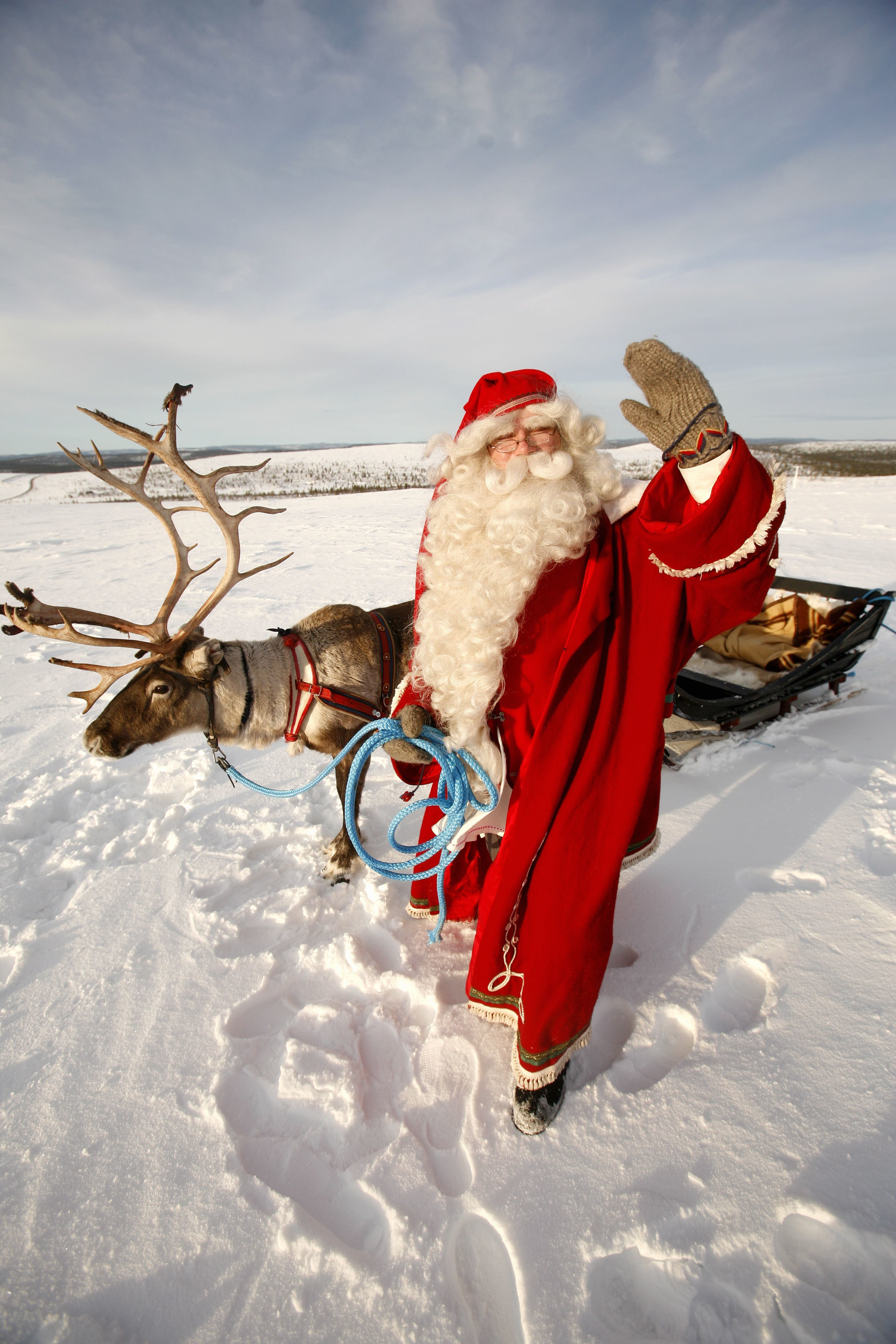
Santa Claus, also known as Saint Nicholas, Father Christmas, and even as Kris Kringle is a figure with mythical, historical, and folkloric aspects. In many western cultures, he is supposed to bring gifts to the homes of the good children during the late evening and overnight hours of Christmas Eve, December 24. The modern figure was derived from the Dutch figure of Sinterklaas.. This legendary being may have part of basis in hagiographical tales concerning the historical figure of a real man, Saint Nicholas. There is a nearly identical story is attributed by Greek and Byzantine folklore to Basil of Caesarea. Basil's feast day on January 1 is considered the time of exchanging gifts in Greece.


Most of us think he always wore the red coat and pants, trimmed in white fur, black boots and belt, and red hat trimmed in white fur and a ball of white fur like a tassel at the end. But that version did not appeared until the 1823 poem, “Night Before Christmas,” written by Clement Clarke Moore, which was called a “A Visit from St. Nicholas.”Thomas Nast, considered to be the father of the American cartoon, was the first to have created the first image of Santa as we know today. But the name, Santa Claus, was first used in the American press in 1773. 


According to a tradition, Santa Claus lives at the North Pole, with a large number of elves, and nine (originally eight) flying reindeer. Since the 20th century, in an idea popularized by the 1934 song "Santa Claus Is Coming to Town", Santa Claus has been believed to make a list of children throughout the world, categorizing them according to their behavior ("naughty" or "nice") and to deliver presents, including toys, fruit and candy to all of the good boys and girls in the world, and sometimes coal to the naughty children, on the single night of Christmas Eve. He accomplishes this feat with the aid of the elves that make the toys in the workshop and the reindeer who pull his sleigh.


Saint Nicholas of Myra is the primary inspiration for the Christian figure of Sinterklaas. A 4th century Greek Christian bishop of Myra (now Demre) in Lycia (now Turkey), Nicholas was famous for his generous gifts to the poor. One well-known tale concerned him presenting three impoverished daughters of a pious Christian with dowries so that they would not have to become prostitutes. He was very religious from an early age and devoted his life entirely to Christianity. In continental Europe (particularly, the Netherlands, Belgium, Austria, and Germany) he is still portrayed as a bearded bishop in canonical robes. In 1087, the Italian city of Bari mounted an expedition to locate the tomb of the Christian Saint and to procure his remains. The reliquary of St. Nicholas was desecrated by Italian sailors and the spoils, including his relics, were taken to Bari where they are kept to this day. Saint Nicholas later became proclaimed as the patron saint of an odd assemble of peoples: archers, sailors, and children, to even pawnbrokers. He is also the patron saint of both Amsterdam and Moscow.There are numerous parallels between Santa and Odin of Norse Mythology. There are theories regarding the pagan origins of various customs of the holiday stemming from areas where the Germanic peoples were Christianized and retained elements of their indigenous traditions, surviving in various forms into modern depictions of Santa Claus. Odin was sometimes recorded, at the native Germanic holiday of Yule, as leading a great hunting party through the sky. Two books from Iceland, the Poetic Edda, compiled in the 13th century from earlier sources, and the Prose Edda, written in the 13th century by Snorri Sturluson, describe Odin as riding an eight-legged horse named Sleipnir that could leap great distances, giving rise to comparisons to Santa Claus's reindeer. Further, Odin was referred to by many names in Skaldic poetry, some of which describe his appearance or functions. These include Síðgrani, Síðskeggr Langbarðr, (all meaning "long beard") and Jólnir ("Yule figure"). According to some traditions, children would place their boots, filled with carrots, straw, or sugar, near the chimney for Odin's flying horse, Sleipnir, to eat. Odin would then reward those children for their kindness by replacing Sleipnir's food with gifts or candy. This practice still survives in Germany, Belgium, and the Netherlands and became associated with Saint Nicholas since Christianization. In other countries it has been replaced by the hanging of stockings at the chimney in homes. 


In the Netherlands, Belgium and Luxembourg, Saint Nicholas ("Sinterklaas", often called "De Goede Sint" — "The Good Saint") is aided by helpers commonly known as Zwarte Piet in Dutch ("Black Peter") or "Père Fouettard" in French. His feast on December 6 came to be celebrated in many countries with the giving of gifts. However, in the Netherlands the Dutch celebrate on the evening of December 5, with a celebration called "pakjesavond". In the Reformation in 16th-17th century Europe, many Protestants and others changed the gift bringer to the Christ Child or Christkindl, and the date for giving gifts changed from December 6 to Christmas Eve. Tradition holds that Saint Nicholas (Sinterklaas) and his aides arrive each year by steam boat from Spain in mid November carrying a book that contains notes on all children that indicate whether the child has been good or naughty during the year and gifts, chocolate letters and spice nuts to be handed to the well-behaved children. During the subsequent three weeks, Saint Nicholas is believed to ride a white-grey horse over the rooftops at night, delivering gifts through the chimney to the well-behaved children, while the naughty children risk being caught by Saint Nicholas' aides that carry jute bags and willow canes for that purpose. 


In contrast to Santa Claus, Sinterklaas is an elderly, stately and serious man with white hair and a long, full beard. He wears a long red cape or chasuble over a traditional white bishop's alb and sometimes red stola, dons a red mitre, and holds a gold-colored crosier, a long ceremonial shepherd's staff with a fancy curled top. He carries a big book that tells whether each individual child has been good or naughty in the past year. He traditionally rides a white gray. Though in the Netherlands and Belgium next to Sinterklaas, the character of Santa Claus is also known, He is known as de Kerstman in Dutch ("the Christmas man") and Père Noël ("Father Christmas") in French. 


An elf in Nordic folklore about the 1840s called "Tomte" or "Nisse" started to deliver the Christmas presents in Denmark. Portrayed as a short, bearded man dressed in gray clothes and a red hat, this creature was obviously inspired by the Santa Claus traditions that spread to Scandinavia then. By the end of the 19th century this tradition had also spread to Norway and Sweden, replacing the Yule Goat. The same thing happened in Finland, but there the more human figure retained the Yule Goat name. But even though the tradition of the Yule Goat as a bringer of presents is now all but extinct, a straw goat is still a common Christmas decoration in all of Scandinavia. Iceland has thirteen Yule lads that originate from folklore rather than Christianity.


Father Christmas goes back as far as the 17th century in Britain. There are pictures of him from that era, where he is a jolly well-nourished bearded man dressed in a long, green, fur-lined robe. He typified the spirit of good cheer at Christmas, and was reflected as the "Ghost of Christmas Present", in Charles Dickens's festive classic A Christmas Carol.


Today, Santa Claus is the image for the Christmas spirit. Parents take their children for photos with Santa at malls and shopping centers. There’s even a website by Norad where you can track then jolly old elf. NORAD SANTA

Now that you learned something of where he originated from, the question is, are you naughty or nice?  After all, you only have a few more days before he descends into your home to leave your present.

Friday, December 11, 2015

Supernatural Friday: Have Yourself a Ghostly Holiday

Long, long ago, people didn’t stay indoors due to the “frightful” weather, but because it might have been dangerous from dark forces that lurked amidst the shadows of the snow drifts. Winter Solstice (December 21) was seen as a time when the fabric between the mortal world and the world of malicious spirits became thin enough for things to snatch unwary victims. Though the fiends are out all year, especially at Halloween (Samhain-(pronounced /ˈsɑːwɪn/ SAH-win or /ˈsaʊ.ɪn/ SOW-in, Irish pronunciation: [sˠaunʲ])—a Gaelic festival marking the end of the harvest season and the beginning of winter or the "darker half" of the year.), still, this time prove to be the scariest.


Many gathered together to celebrate and they hoped that the dark spirits would realize that with all the din that there might be too many bodies inside or caroling outside to grab one person. Another custom practiced were doors flung open at midnight to let out trapped evil spirits caught inside the building. A candle left burning in the window all night insured good luck for the family inside. Any candle that burned out before dawn was considered a bad sign.


It was also said that those born on Christmas are apt more to see a spirit than those not. Though they had nothing to fear from any ghost if they chance to encounter one. These same people were also protected against deaths by drowning or hanging.


This time of year ghost stores were told. Those Victorian people did more than go Christmas caroling or drank mulled wine by the roaring fires. Just as much as Halloween. This might be a good reason Charles Dickens wrote his novel, A Christmas Carol. There’s even that line in the song,  ‘It's the Most Wonderful Time of the Year’ that goes "There'll be scary ghost stories and tales of the glories of Christmas long, long ago," that point to this.


Novels and anthologies come out this time of the year, ghostly fiction or horror stories, many set around the holidays. This year, there is a graphic anthology, Krampus: Shadow of Saint Nicholas by Michael Dougherty, that released. I purchased it to read for a book club and reviewed it for I Smell Sheep Reviews. It is connected to the new Christmas movie, Krampus, and tells of people in a small town that encountered Krampus (a Christmas devil from pagan times who is also considered Santa’s dark shadow who takes bad children to Hell) who came one night. There is also a book of fiction I found titled Christmas Ghosts, edited by Kathryn Cramer and David G. Hartwell. Of course, there is A Christmas Carol by Charles Dickens. Perfect read for this time of the year. Nineteen years after A Christmas Carol was published, Dickens published another ghost story (no elements of Christmas in it, but still what Victorians like to tell around Christmas time) in the Christmas edition of the publication All Year Round. 

Many more exist, just search Amazon or check out your local brick and mortar independent bookstore, Barnes and Noble, or Books A Million. Or go to your library and ask your librarian.


So, besides a season of “good tidings,” it is also a time of terrible fear. Make sure your children are in at night and make sure they stay good. And the same for yourself. For you never know if that shadow moving along the street past your front yard is just someone looking at your Christmas lights, or something else waiting to get you.


                Have a Scary Little Christmas!

Friday, December 04, 2015

Book Signing at Books, Beads and More in Mechanicsville, Virginia December. 5, 2015

Catch me tomorrow, from 11:00 a.m. to 3:00 p.m. at Books, Beads and More. Not just a bookstore that has new and plenty of used books, but also sells crafts, art, and handmade jewelry by local artisans.  I will sign as both Pamela K. Kinney (includes the new nonfiction ghost book, Paranormal Petersburg, Virginia, and the Tri-Cities Area, and the anthology, Nightmares and Echoes 2: The Return, that includes my horror story, "Silence."), and as my pseudonym, Sapphire Phelan my erotic urban fantasy novel, The Witch and The Familiar, and a new anthology, Shivers and Lace that includes a new erotic paranormal, "Pick Up Date," by me.

The address for Books, Beads and More is 8324 Bell Creek Road, Ste. 100, Mechanicsville, Virginal 23116. They are conveniently located near Henrico and Richmond, of Pole Green Road. Their phone number is 804-730-2665. 


Supernatural Friday: You Better Watch Out! You Better Beware! Krampus Is Coming for You!


Christmas is not just a time of joy, gifts, and goodwill, it’s also a season of dark myths and legends. In the olden days in Finland, they believed in Joulupukki. That word means Yule buck.


In December, pagan people had big festivals to ward off the Joulupukki. These spirits of darkness wore goat skins and horns. In the beginning this creature didn't give presents but demanded them. It was an ugly creature and frightened children. It is unclear how this personality was transformed into the benevolent Father Christmas. Nowadays the only remaining feature is the name. The process was probably a continuous amalgamation of many old folk customs and beliefs from varied sources. One can speak of a Christmas pageant tradition consisting of many personages with roles partly Christian, partly pagan: A white-bearded saint, the Devil, demons, and house gnomes. Nowadays the Joulupukki of Finland resembles the American Santa Claus. While most gift givers around the world deliver their presents in the middle of the night while everyone is sleeping, children in Finland get to see Joulupukki in the act of delivering the presents.
 
This reminds me of Black Peter and the Krampus, both being Santa’s “evil twin.” In many areas of the world, it is said that St. Nicholas has a companion. This companion is Krampus, though another version is Black Peter, or Zarte Piet or Zwarte Piet. Black Peter is associated with the Netherlands and has dark skin. Though Krampus isn't a man. He has horns, goat hair, hooves, and claws, not unlike a demon. His job is to accompany St. Nicholas and to warn and punish bad children. He is said to carry a basket on his back where he will place the bad children and take them to Hell to be tossed into the pit. It puts a frightening twist on “have you been naughty or nice!” And Krampus may be in some parts of Germany, in other Germanic regions there are Belsnickle and Knecht Ruprecht. While  France has Hans Trapp and Père Fouettard.


Krampus originates from Krampen--meaning claw. He is is said to be the son of Hel in Norse mythology. Krampus is the dark companion of St. Nicholas, the traditional European winter gift-bringer. According to folklore, Krampus purportedly shows up in towns the night before December 6, known as Krampusnacht, or Krampus Night. December 6 also happens to be Nikolaustag, or St. Nicholas Day, when German children look outside their door to see if the shoe or boot they'd left out the night before contains either presents (a reward for good behavior) or a rod (bad behavior).
 
This fiendish being is usually seen as a classic devil with horns, cloven hooves and monstrous tongue. Unlike American children who get coal if they’re bad, instead the Krampus beats them savagely for their misdeeds and then drag them down to hell. Born of a pre-Christian, Alpine Pagan tradition, he is identified by matted-black hair, along tongue that snakes out of his maw, and cloven hooves. He also sports a large wicker basket on his back, filled to the brim with thorny, unbreakable birch sticks for those beatings he delivers. He always comes with St. Nick who brings presents, but before the gifts are handed out, those who are bad is given what they "deserve" by him. 
 
A more modern take on the tradition in Austria, Germany, Hungary, Slovenia, and the Czech Republic involves drunken men dressed as devils, who take over the streets for a Krampuslauf. This is a Krampus run, where people are chased through the streets by the "devils."With marathons where people run from zombies, this might the next new holiday marathon.  Why not runners bolting from Krampus devils with switches?

There would be young men that dress up in goat skins and masks they spent two weeks making and on December 5th, head out to scare all, and carry out "birching," mainly on young girls. Krampus makes the Grinch before his heart went several sizes bigger look like a goody two-shoes.

The Catholic Church forbade the raucous celebrations. Then fascists in World War II Europe found Krampus despicable because it was considered a creation of the Social Democrats.

Krampus is making a comeback now, due to the "bah, humbug" attitude in pop culture. Krampus walks—like the RVA Krampusnacht  to be held tomorrow night in Richmond that I will have to miss as being out of town— and Krampus parties are coming back with a vengeance.  Some can be found here: Krampus.com

Austria is commercializing the harsh persona of Krampus, selling chocolates, figurines, and collectible horns.  There are Krampus ugly sweaters, sweatshirts, postcards and more that on can purchase of their favorite Yuletide demonLooks like Krampus is fast on his way to becoming commercialized.

Gruss vom Krampus!


Thursday, November 26, 2015

Supernatural Friday: Mourning Moon


November's full moon that happened for past three days (including Thanksgiving) has always been a signal of the changes to come. As the last full moon before the Winter Solstice, it's seen as the final bit of light before the darkness of winter. It's also known as the "Mourning Moon."

Many modern-day superstitions surround the moon in general. The full version has long been upheld in Paganism as a time, every month, to reflect. People who follow Pagan traditions spend the autumn preparing for the colder months. The final step in this process is the letting go of old things — what we must leave behind before we reach the new year. Hence, the "mourning."


Cleansing rituals are conducted in observance of the Mourning Moon. Discarded things can be anything from the most frivolous—like nail biting or chewing on pencils and pens—to deeply profound (the grief over a lost loved one). What the point is, to think of these things one last time before moving on from them. Make a list and drown it in a jar of water (the element is associated with this full moon). Or you can perform a modern version by adding your list to a note on your phone, and then delete it. 


Friday, November 20, 2015

Supernatural Friday: Not Supernatural, but Happy Thanksgiving!


Since I have been busy, writing my NaNoWritMo novel and my husband took the day if today s we could go see "Mockingjay, Part 2" and do some grocery shopping for Thanksgiving, I am sharing this no supernatural peom writte by me for Thanksgiving. Enjoy.


I'm thankful for many things,
Like friends and family,
While pets and books also top that list.
How about simple things?
Butterflies on a spring day,
A lit Jack-O-lantern on Halloween night
Crying over a beautiful love story,
Or laughing over a silly joke.
But most of all, I can say
I'm thankful for life and what it brings each day.


Poem copyrighted by its author, Pamela K. Kinney


HAPPY THANKSGIVING!