Showing posts with label devil. Show all posts

Friday, August 31, 2018

Supernatural Friday: A Ghoulish Last Friday in August

"They are neither man nor woman
They are neither brute nor human
They are Ghouls" 
— Edgar Allan Poe


Image result for ghoul images


When George Romero's Night of the Living Dead came out, the press called the undead zombies. Except Romero never coined them that term. Instead, he had called them ghouls. Which would be the right term, as zombies are connected to voodoo and are people drugged and controlled, not flesh-eating monsters.

What are ghouls? A ghoul is a legendary evil being that robs graves and feeds on corpses.  It is one who shows morbid interest in things considered shocking or repulsive and supposedly lives in burial grounds. 


In Arabic folklore, ghouls are a type of jinn that could change their shapes but had one unchanging feature: donkey's hooves for feet. Even more horrible, it kills young children and even can lure unwary folk into abandoned places. By extension, the word ghoul is also used derogatorily to refer to a person who delights in the macabre, or whose profession is linked directly to death, such as a gravedigger.
Ghoul is from the Arabic ghul, from ghala "to seize." It is even thought to come from Gallu, a Mesopotamian demon. In Sumerian and Akkadian  mythology, the Gallus (also called gallu demons  or gallas [Akkadian: gallû]) were great demons/devils of the underworld. Their job was to haul off unfortunate victims to the underworld and even accompanied Istar when she headed down to the underworld.


The ghul is a fiendish type of jinn believed to be sired by Iblis, known to the Devil in Islam. A ghoul is a desert-dwelling shapeshifting demon that can assume the guise of an animal especially a hyena. It lures unwary people into the desert wastes or abandoned places to slay and devour them. The creature also preys on young children, drinks blood, steals coins, and eats the dead, taking the form of the person most recently eaten. In the Arabic language, the female form is given as ghouleh and the plural is ghilan. In colloquial Arabic, the term is sometimes used to describe a greedy or gluttonous individual.


In stories and films, I think Gollum is the closest to the idea of a ghoul, and I wouldn't be surprised this is what Tolkien had in mind when he wrote him into The Hobbit and The Lord of the Rings trilogy. What other beings in books or TV or film, do you believe are ghouls?


Friday, April 13, 2018

Supernatural Friday: A Basket of Thirteens for You-Friday the 13th!


There’s nothing more invigorating on this day than a basket of 13 black cats. Right?

For many reasons, people feel Friday then 13th is a day of bad luck. Not so for me, 13 is my lucky number. Over the years, I've won prizes and money with this number. Heck, I own a black cat!

2018 has double the trouble as Friday the 13th happens again in July.

The fear of Friday the 13th is called paraskavedekatriaphobia, a word derived from the concatenation of the Greek words Paraskeví (Παρασκευή) (meaning Friday), and dekatreís (δεκατρείς) (meaning thirteen), attached to phobía (φοβία) (meaning fear). The term is a specialized form of triskaidekaphobia, a simple phobia (fear) of the number thirteen appearing in any case.

Both the number thirteen and Friday have been considered unlucky:
In numerology , the number twelve is considered the number of completeness, as reflected in the twelve months of the year, twelve recognized signs of the zodiac, the twelve tribes of Israel, the twelve Apostles of Jesus, etc., whereas the number thirteen was considered irregular, transgressing this completeness. There is also a superstition, thought by some to derive from the Last Supper, that having thirteen people seated at a table will result in the death of one of the diners.

Friday, as the day on which Jesus Christ was crucified, has been viewed both positively and negatively among Christians. The actual day of Crucifixion was the 14th day of Nisan in the Hebrew Lunar calendar which does not correspond to "Friday" in the solar calendar of Rome. The 15th day of Nissan (beginning at Sundown) is celebration of Passover.


In the 20th century, only did the superstition receive greater audience, as Friday the 13th doesn't even merit a mention in E. Cobham Brewer's voluminous 1898 edition of the Dictionary of Phrase and Fable, though one does find entries for "Friday, an Unlucky Day" and "Thirteen Unlucky." When the date of ill fate finally does make an appearance in later editions of the text, it is without extravagant claims as to the superstition's historicity or longevity. Though the superstition developed relatively recently, much older origins are often claimed for it, most notably in the novel, The Da Vinci Code (and later the film), which traced the belief to the arrest of the Knights Templar on Friday October 13, 1307.

Friday the 13th has for years been considered a day to watch out for. A study done in 1993, by authors in the British Medical Journal have proven more car accidents are higher on the 13th than on normal Fridays.


Both the number 13 and the sixth day of the week have foreboding reputations since ancient times. Those who fear something bad will happen on the 13th, will not go to work, eat, etc...

The number 13 is also connected with a legend. It is said, that if thirteen people sit down to dinner, one of them will die within the year. Many cities do not have a 13th Street or Avenue. There are buildings without a thirteen floor. Having thirteen letters in your name means you will have the devil's luck. People with 13 letters include Jack the Ripper, Jeffrey Dahmer, Charles Manson, Theodore Bundy, Albert De Slavo, to name a few.

Turks have a dislike so much for the number that it is almost stricken from their vocabulary. And of course, everyone knows there are thirteen witches in a coven!

To give the argument from the other side: Chinese consider the number to be a sign of luck. Egyptians used this for spiritual ascension--twelve in their life and thirteenth beyond, meant to be eternal afterlife.

It is thought that western civilization reviled the number as it is considered feminine--used by prehistoric goddess-worshipping cultures. It corresponded to the lunar (menstrual) cycles in a year.


Millions of Americans have a fear of Friday the 13th in this day and age. It has been proven that the number of hospital admissions due to vehicular accidents was significantly higher than on "normal" Fridays. Does it keep most of them from venturing out to work and more? No. Though I wouldn't be surprised if they carry a rabbit's foot in their purse or pocket, or something that they believe is lucky for them. 

What plans are you making to do today for the 13th--stay home safe and sound or go out as usual? Do you believe in the 13th being a unlucky day or not? Thirteen is just a number--right? It's just another day. 


OR IS IT?  💀💀


Friday, September 25, 2015

Supernatural Friday: Jack-O-Lantern-Truth and Folklore

Next Friday, there will be no Supernatural Friday, as I will be on a book tour for my new release, Paranormal Petersburg and the Tri-Cities Area, and stop on my log on Tuesday, September 28th, so come back then and leave a comment with your and email to be entered to win a signed copy of my book.  Next Friday, I will be stopping on Lela Markham's Blog


We carve jack-o-lanterns from pumpkins around Halloween. People carve monstrous faces the pumpkins wear friendly faces, or famous characters from movies, TV and books--like the stormtrooper one my husband carved in one of the craft pumpkin we bought a few years ago. And yes, you don't have to use the gourds you find at the supermarket or grown at pumpkin farms, you can use craft pumpkins found at craft stores, too. You can also paint pumpkins even. This is safer for children to do, rather than using carving implements. They can use their own paints to paint cool faces or by using stencils, faces or scenes on the flesh of the pumpkin.

This tradition of making a jack-o-lantern goes back long ago in Ireland. They used turnips then. The Irish carved these vegetables and left them on doorsteps to ward off evil spirits. But it did not become part of Halloween until 1866. That was in America, and not in Ireland or Britain. There is no documented proof to substantiate that the jack-o-lanterns were ever part of Halloween before this date.
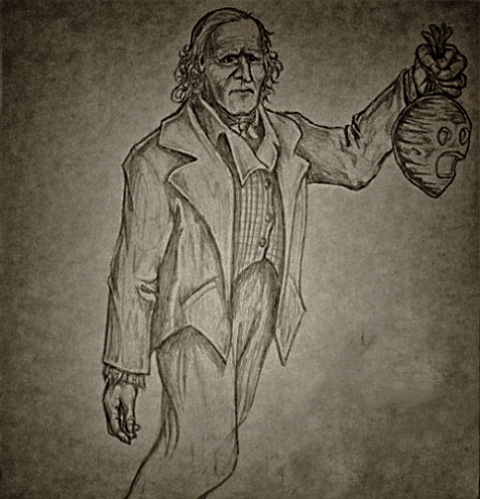
There is folklore behind the jack-o-lantern. In one version of the story, Stingy Jack was a miserly old man who runs into the Devil. He asks if the Devil would turn into a coin he could use to pay some Christian villagers he owed. These that would be a great joke.

But Jack pocketed him. He had a cross in the pocket, too. The Devil was stuck, and the only way he would be freed was if he promise not to take Jack's soul when he dies. The Devil agreed to the deal and set free.

Jack finally passes away. His spirit tries to enter into Heaven, but the gates remain shut to him. There is too great of a stain on his soul for Heaven to allow him inside. And thanks to his agreement with the Devil, he discovers that he is barred from Hell, too. The Devil tosses him a turnip and an ember made from Hellfire.

“Take that turnip, dig all its insides out, and place the ember inside it. Use it as a lantern to find your way across the mortal world to find a resting place. That is all I will do for you. Good riddance.”

So with only the lantern to light his way, Jack wanders the earth and searches for a resting place. He never finds it. Jack became known as Jack-o'-Lantern.
There are other versions of this Irish tale, even an African-American one. One of those tales uses the Grim Reaper in place of the Devil, The Grim Reaper takes Jack's head to Hell with him. Jack uses a pumpkin to replace his head.

When you carve that pumpkin, and set a lighted candle or battery operated candle inside it, stand on your porch and watch the costumed children wandering the street. Think of Stingy Jack, doomed to roam the earth forever.


Will you take pity on him if he comes to your door?

Thursday, October 09, 2014

Supernatural Friday: Eleven Spooky Supernatural Reads for October


For this Supernatural Friday, I decided to do eleven spooky reads perfect for October and Halloween. Not to say, they aren't wonderful, to read any other time. There are more creepy novels and short stories I can tell you about, but then that might go into the hundreds. Instead, I feel these eleven will be a great start for you. Plus at the end, there is a link for my own scary ghost story that made the top seven stories for Small Press Award 2013.  Now get reading!

1.     The Haunting of Hill House by Shirley Jackson (It’s not Halloween without a great, scary ghost story. This is the only novel to scare me during the daytime, in a room full of middle school student. My parents landlady had given this book and Jackson’s We Have Always Lived in the Castle (another good read), so after getting my work in class done early the teacher said I could read my book, so I did. The scene I read freaked me out.)

 Front Cover

2.     The Wolfen by Whitley Strieber (A werewolf horror novel, but where the werewolves are shifters, but a race living alongside humans since prehistoric times.  Though no longer in print (you can find it used—I did—it is available of Kindle and Nook.
 Book blurb: In the dark, they are watching...
They are waiting for you. No one has ever lived to tell the horrifying truth about them. Yet even now the Wolfen are gathered in the night-dark alleys ... unseen, poised ... ready to destroy their helpless human prey. Only one man and one woman, trained cops, willing to risk their lives, stand in the way.)

3. Bad Wolf by Tim McGregor (I got this free on Kindle—which I see it is again—and though self-published, it was good. Enough for me to buy the second two in the Bad Wolf Chronicles trilogy.

 Book blurb: Detective Lara Mendes’s hard work finally pays off   when she gets the chance to join the homicide detail. There’s only one catch; she has to partner up with a cop no one wants to work with.

John Gallagher is a veteran homicide detective who loves stomping bad guys and hates partners. When the Lieutenant saddles him with this green kid named Mendes, his first reaction is to ditch her but a call comes in about a body on the river bank and the rotation says they’re up.

What they find are human remains, mutilated and partially devoured. Their investigation reveals a killer stalking the city with a pack of vicious, feral dogs.
And the suspect believes he is a werewolf.

But this is Portland, where crazy bastards outnumber normal ones ten to one. Except there’s another catch. The crazy werewolf guy? He isn’t crazy...


4.     Dracula by Bram Stoker( Forgot that Twilight junk and read the vampire that start it all (even though there was a vamp novel before him). With ‘Dracula Untold’ coming to movie theaters, showing how he became the monstrous Count, I would suggest start reading the book. And no, he may walk in the daytime, but he does not sparkle! If cannot afford the book or eBook, or it’s out at your library, you can read it free here: http://www.literature.org/authors/stoker-bram/dracula/  or get it at Gutenberg as download for free: http://www.gutenberg.org/ebooks/345 Read the short story, “Dracula’s Guest” for free at http://www.literature.org/authors/stoker-bram/draculas-guest/ or get it at Gutenberg too, as free download: http://www.gutenberg.org/ebooks/10150


5.     Hell House by Richard Matheson (You think it was Hill House again, but it is not. What really haunts Hell House?

Front Cover

6.     “The Monkey’s Paw” by W.W. Jacobs (Not a novel, but a very, scary ghost story. Remember that motto, “Be careful what you wish for?” as this story fits it so well. Sometimes the dead should remain dead.) The Monkey’s Paw,” one of the most bone-chilling and frequently anthologized stories of all time. Readers will find it difficult to believe that W(illiam) W(ymark) Jacobs (1863-1943) gained his fame as a writer of humorous tales, as there is no hilarity to be found here. It has been adapted relentlessly: for radio, as a 1907 play, motion pictures (several silent films as well as a 1933 talkie and a 1948 remake), for television as episodes of Suspense, Great Ghost Tales, The Alfred Hitchcock Hour, and Great Mysteries, and for three operas. “The Monkey’s Paw” was first published in the September 1902 issue of Harper’s Monthly; it was collected in The Lady of the Barge (London, Harper, 1902). You can read it here for free.


7.     All of H.P. Lovecraft’s stories and novels (Something about the Old Ones that can creep to a person, don’t you agree?)


8.     Salem’s Lot and It by Stephen King (I compiled these two together, as both scared me when I read both books alone in my bedroom, just before bedtime. )

      Front Cover

9.    Something Wicked This Way Comes by Ray Bradbury (I love all of Ray Bradbury's works, but this one is a great favorite of mine.

Few American novels written this century have endured in th heart and mind as has this one-Ray Bradbury's incomparable masterwork of the dark fantastic. A carnival rolls in sometime after the midnight hour on a chill Midwestern October eve, ushering in Halloween a week before its time. A calliope's shrill siren song beckons to all with a seductive promise of dreams and youth regained. In this season of dying, Cooger & Dark's Pandemonium Shadow Show has come to Green Town, Illinois, to destroy every life touched by its strange and sinister. 


 Front Cover

10.     Rosemary’s Baby by Ira Levin (Got to have one demon or Devil story with witches to read for Halloween. Forget The Exorcist—that bored me—but this one stuck in my mind for years.


11.  Complete Tales and Poems by Edgar Allan Poe (You thought I would forget him? Heck, no! He’s is perfect for this time of the year.)


Now read my fictional ghost story, Bottled Spirits at BuzzyMag.com for free. 

Thursday, October 10, 2013

Supernatural Friday: Legend of Stringy Jack-One Day Early

I will be out of town for Friday and Saturday at Capclave, so enjoy this Halloween legend that I did last year.


Come now, friends and fiends, and enjoy the following  tale behind the jack-o-lantern. Every October, carved pumpkins peer out from porches and doorsteps in the United States and other parts of the world. Gourd-like orange fruits inscribed with ghoulish faces and illuminated by candles are a sure sign of the Halloween season. The practice of decorating “jack-o’-lanterns”—the name comes from an Irish folktale about a man named Stingy Jack—originated in Ireland, where large turnips and potatoes served as an early canvas. Irish immigrants brought the tradition to America, home of the pumpkin, and it became an integral part of Halloween festivities. One day down and counting to. . . HALLOWEEN!


Stingy Jack was a miserable, old drunk who loved playing tricks on anyone and everyone. One dark, Halloween night, Jack ran into the Devil himself in a local public house. Jack tricked the Devil by offering his soul in exchange for one last drink. The Devil quickly turned himself into a sixpence to pay the bartender, but Jack immediately snatched the coin and deposited it into his pocket, next to a silver cross that he was carrying. Thus, the Devil could not change himself back and Jack refused to allow the Devil to go free until the Devil had promised not to claim Jack's soul for ten years.

The Devil agreed, and ten years later Jack again came across the Devil while out walking on a country road. The Devil tried collecting what he was due, but Jack thinking quickly, said, "I'll go, but before I do, will you get me an apple from that tree?"

The Devil, thinking he had nothing to lose, jumped up into the tree to retrieve an apple. As soon as he did, Jack placed crosses all around the trunk of the tree, thus trapping the Devil once again. This time, Jack made the Devil promise that he would not take his soul when he finally died. Seeing no way around his predicament, the Devil grudgingly agreed.

When Stingy Jack eventually passed away several years later, he went to down to Hell to see the Devil, but the Devil kept the promise that had been made to Jack years earlier, and would not let him enter.

Thinking, Ah, Heaven will surely let me in then!, he wandered up to the Gates of Heaven, but was refused entrance because of his life of drinking and because he had been so tight-fisted and deceitful.
 
Jack went back to Hell to see the Devil.

"Where can I go?" asked Jack.

"Back to where you came from!" sneered the Devil. "You doomed yourself to roam the earth, a restless soul who can find no rest ever." Lucifer tossed him a turnip and a ember straight from the fires of Hell itself. "Here, hollow out this turnip and place this ember inside. Use its light to find your way through eternity." 

And to this day, Jack wanders, never stopping in one place, a hauntingly lost soul, who learned you never ever really beat the Devil at his own game.

Thursday, September 19, 2013

Supernatural Friday: The Devil in Folklore


The Devil is one of two main characters in my newly released short story, “Devil in the Details”  in the anthology, Harboring Secrets. The protagonist for ages against God and his angels, he has been known as Lucifer, a fallen angel, Satan, the Great Horned God, Mammon, dragon, Father of Lies, Abaddon, Accuser, Apollyon, Cloven Hoof, Beast, Beelzebub,  and Belial, to even name more names. The Devil is believed in many religions, myths and cultures to be a supernatural entity that is the personification of evil. The nature of the role varies greatly, ranging from being an effective opposite force to the creator god, locked in an eons long struggle for human souls on what may seem even terms to being a comical figure of fun or an abstract aspect of the individual human condition.

While mainstream Judaism contains no overt concept of a devil, Christianity and Islam have variously regarded the Devil as a rebellious fallen angel or demon that tempts humans to sin, if not commit evil deeds himself. In these religions, the Devil has assumed more of a dualistic status commonly associated with heretics, infidels, and other unbelievers.
In mainstream Christianity, God and the Devil are usually portrayed as fighting over the souls of humans, with the Devil seeking to lure people away from God and into Hell. The Devil commands a force of evil spirits, commonly known as demons. The Hebrew Bible (Old Testament) describes the Adversary as an angel who instigates tests upon humankind. Many other religions have a trickster or tempter figure that is similar to the Devil. One of these is Loki in the Norse mythology.

In one legend from Colonial America, the lawyer Daniel Webster goes up against the Devil and wins. There’s even a well know rock country song, 'Devil Down in Georgia,' where the fiddler in the story out fiddles the Devil. Another is folklore about a real person in history, Colonel Philip Lightfoot must danced against the Devil to save his land  at what is known as Dancing Point today. The legend says that the Devil caused the barrenness in the land and remarked that it was his, not Lightfoot’s. Colonel Lightfoot agreed to a contest between the two of them. They would see who was the best dancer and could last the longest, with the land as the prize. They marched to Dancing Point at dusk and shed their coats and tricorns. After building a large fire, both proceeded to dance their hearts out. Around and around a tree stump they whirled. Lightfoot had claims to being an accomplished dancer and he proved it that night. The Devil didn’t give up, as he was determined to win, but when the first rays of dawn painted the morning sky, the Devil knew he had lost. He limped away in humiliation, crossing the James River to Surry County. The old-timers report that he still lives there. This tale is in chapters in my Haunted Virginia: Legends, Myths and True Tales and Virginia's Haunted Historic Triangle: Williamsburg, Yorktown, Jamestown, and Other Haunted Locations. 

Another tale is about the Blues singer Robert Johnson who is supposed to have met the Devil at a crossroads in Mississippi, the Devil took his guitar off of him, tuned it, played a few songs and gave it back, from then on Robert Johnson could play the Blues better then anyone alive.


But most times, the human doesn’t win and loses his/her soul. Just as what happens to my heroine in “Devil in the Details.” Another such folklore where the mortal lost concerns a girl rushing to a dance. Her mother forbids her to go, saying the preacher said the dance was going to the devil. The girl goes anyway and ends up dancing with this handsome young man. He whiles her around ad around until she vanishes. He then bows to others at the dance and vanishes. The girl is winging her way to Hell.

There is also one from Devon England that in the 1800's a set of footprints in the shape of hoofs appeared over night in the snow going for hundreds of miles appearing to go straight over the roofs of houses and barns.

There are tons of stories of the devil in southern folklore. One told of how the devil would hide among goat herds in the form of a large billy goat. When a prospective sinner drew near, the devil stood on his hind legs and follow him until the person came to a crossroads. If the sinner would turn to confront the devil before he/she reached the crossroads, the devil took his/her soul. If not, then the sinner had best get to church as soon as possible and confesses his sins before he pass those same crossroads again. In the French-Canadian folktales of the 19th century argues that the legends involving the Devil can be categorized according to a trinity of basic tale types. The first type is the “beautiful dancer,” the second is the “builder of bridges and churches” and the final is the “instigator of pacts.”

Devil be or not, one should never sell their soul to strangers, for after all, the Devil is the Prince of Lies after all.


Here is short excerpt from "Devil in the Details."

They say the devil is in the details. Most especially when one sold their soul to the Devil in a literal sense. Then life and death becomes extremely important. 

I should have read that contract better before I signed it in blood ten years ago. 

Jenna tossed back the glass of scotch she held. The amber liquid burned a path down her throat to her stomach. The glass clinked loud as she set it down next to the empty bottle. It toppled over and spilled the scotch across the table’s surface. 

A giggle escaped her. Who gave a damn about a mess on one measly table? Or that she never been so drunk in her life. Not with her soul in trouble. Hell put things into perspective.

Buy Harboring Secrets in print at Amazon, Barnes and Noble, Books A Million and at your local independent bookstore. It is also available  on Kindle and as a Nookbook on BarnesandNoble.com. 


Wednesday, March 27, 2013

Got a Short Story of Mine Accepted for an Anthology

I am happy to report that my short horror story, "Devil in the Details" was accepted for an anthology, Harboring Secrets: Tales & Reflections from the Chesapeake Bay Writers. 


Monday, October 24, 2011

Beware of the Devil Monkeys!


Thus begins for days leading up to Halloween on ghosts, monsters, the Bunnyman and other serial killer urban legends, and other terrifying things. Then on Halloween, there will be a special Halloween horror fiction of mine for all to enjoy.

Today, we'll talk about a Southern legendary monster, the devil monkey. Devil monkeys are described as baboon-like creatures able to leap like kangaroos. They have dark, “mean” eyes, pointed ears, short to shaggy fur that varies from red to gray to black, and large flat feet. Ranging in height from three to eight feet, it is said that they won’t back down, even from dogs, and although thought to be vegetarians, there are stories told of them killing livestock and small game. They exhibit a range of primate hoots, calls, screeches, whistles, and unearthly screams, and have an odor so bad, they have been also called Skunk Apes. It has been seen in the area of the Appalachian  Mountains to even in British Columbia.


A cryptozoologist, Chad Arment, investigated the sightings of these creatures that one Virginia family and their friends had experiences with. This occurred from 1959-1990s, in the mountains that surround Saltville.


Paranormal investigators Pauline and James Boyd’s parents were attacked in 1959 by a creature that left three scratch marks on their car. Not long after, a couple of nurses were driving home when an unknown animal attacked their vehicle, ripping the convertible’s top off. Badly shaken, they escaped otherwise unharmed.


Friends of Pauline saw one of these creatures trotting across the road in front of their car. It leaped over a ditch, glided over a fence, and bounded through weeds along the road.

Other sightings have occurred as recently as 2001, when a giant black monkey was seen nine different times over the course of two weeks in rural New Hampshire. It has even been told that a search party was formed to track one of these they thought was a devil monkey, but that the dogs refused to follow the trail.

Another beast, the "Belt Road Booger” was encountered by several people in Georgia in the 1970s. It was thought this might have been a devil monkey. The Nalusa Flaya of Choctaw legend bears a strong physical resemblance to the devil monkey, though the devil monkey does not appear to have any of the supernatural abilites attributed to this legendary monster.

 What are these devil monkeys? Some people think devil monkeys are feral monkeys released into the wild or escaped from research facilities, such as the ones that broke free in Florida due to Hurricane Andrew in 1992. Cryptozoologists think that are a surviving species once thought to be extinct, like a fruit-eating spider monkey originating from Brazil, or a large baboon that lived 650,000 years ago in East Africa. Maybe they could even be a sort of Sasquatch?  Or could these beasties be nothing more than an illusion? Whatever devil monkeys are, they are a fascinating tale to tell on Halloween around the hearth fire or around a campfire.


In 1996, a woman named Barbara Mullins was driving down a stretch of road in Louisiana known as Highway 12 when she noticed something odd on the side of the road. At first Mullins through the carcass she had found was that of a dog, that was until she saw it’s baboon like features. Mullins snapped several pictures of the carcass with her camera; the resulting images have been the topic of much debate in the cryptozoology world. The creature was described as being about the size of a large adult Saint Bernard and covered with a think coat of dark wooly hair. It's most notable attribute was its decidedly simian features, extended feet, and small, presumably pointed ears. I went to the website with the pictures and concluded myself it was nothing more than some dog, maybe gone feral. To me, there was nothing ape-like or monkey-like in the dead animal's appearance.


Was that a screech you heard in the night? Beware, it just might be the. . .devil monkey!