Showing posts with label Friday. Show all posts

Friday, August 03, 2018

Supernatural Friday: Slender or Tall, He's Out to Scare You!

The Slender Man is an urban legend of a mythical creature often depicted as a tall, thin figure wearing a black suit and a blank face. According to the legend, he can stretch or shorten his arms at will and has tentacle-like appendages protruding from his back. Depending on the interpretations of the myth, the creature who seems to be no unlike the men in black ufo stories can cause memory loss, insomnia, paranoia, coughing fits (nicknamed “slendersickness”), make photograph/video distortions, and can teleport at will.  Where he comes from is as much a mystery as what he wants. All that is known is that there is evidence of him existing for far longer than one would expect. Those who see him often wind up missing or worse, their mutilated bodies are impaled upon a tree, their organs removed, and then replaced in a systematic way. Supposedly, sightings of this creature have been seen in many places around the world, including the United States, Norway, and Japan. The story goes that those who have seen him are frequently found to be maniacally writing strange messages, and drawing mad scribbles of a dark, faceless figure. It is advised that one stops investigating too much, otherwise will find that you become the subject of unwanted interest. There will be a horror movie coming out next week in movie theaters, Slender Man. You can view the trailer here: Youtube.


Supposedly, in June 2009, a “’paranormal pictures” photoshop contest was launched on the ‘Something Awful’ Forums. The contest required participants to turn ordinary photographs into creepy-looking images through digital manipulation and then pass them on as authentic photographs on a number of paranormal forums. Something Awful users soon began sharing their faux-paranormal creations with layered images of ghosts and other anomalies, usually accompanied by a fabricated witness account to make them more convincing. One of the forum users on June 10th had posted two black and white photographs of unnamed children with a short description of “Slender Man” as a mysterious creature who was stalking the kids in the photographs. Another user of the forum reused the Slender Man character for his own story. The original thread, which still remains active today, extends for 46 pages as of June 2011.


The creation of “Slender Man” may have inspired an ongoing series of amateur adventure games titled “Chzo Mythos.” Published by Ben ‘Yahtzee’ Croshaw in 2003, one of the main villains is called Cabadath. It is also referred to as “Tall Man.”Making his first in-game appearance in Trilby’s Notes, the character was portrayed in the third installment as a tall, thin man dressed in a long, black, high-collared coat with tails that reach to the floor and having a blank face.


But this slender man or tall man has more far-reaching stories from old legends. There is Der Großmann, German for “The Great Man,” is often translated as The Tall Man, too. It is rumored to be a German folklore concerning a tall boogeyman existing since the 16th century. The Tall Man also abducts children, just like the Slender Man is supposed to. There is a horror film about the Tall Man, called “The Tall Man,” that came out in 2012: http://www.imdb.com/title/tt1658837/. Even the fiend in the Phantasm movies is called the Tall Man.No doubt, the game developers took this being and using “Slender Man” for the name of their villain, put him into their game. 


From what I could find, there are some old legends for the Great Man or tall Man, but I suspect that the Slender Man has been fabricated on more and more in modern times, with help by the Internet, not unlike the Bunnyman of Virginia. 


But just in case I am wrong, if you see an extremely tall, thin man dressed all in black not far from a children’s playground, maybe you should take heed. Especially before you forget. . .

Tuesday, February 13, 2018

ON Speculative Fiction Cantina This Friday, February 16, 2018!

I will be reading from my urban fantasy novel, How the Vortex Changed My Life this Friday, February 16, 2018 at the blogradio show, Speculative Fiction Cantina. I'm sharing the hour with another author, Judith Howell.

You can listen at Speculative Fiction Cantina The times  are 6:00-7:00 p.m. Eastern, 5:00-6:00 p.m. Central, 4:00-5:00 p.m. Mountain, and 3:00-4:00 p.m. Pacific. And you can call in to speak with the host at (347) 945-7246 with any questions that evening.


Friday, March 17, 2017

Supernatural Friday: St Patrick Day's Legends


Once upon a time, blue was the color to wear. That's right, not green, but blue! Because blue was the color of Ireland's flag. It was changed to green most likely due to the shamrock.

St. Patrick chased the snakes out of Ireland. Except that would be hard, as there never been snakes in Ireland. Separated from England and the Continent thousands of years ago, Ireland emerged from the Ice Age snake-free.

And forget that cute little guy on the Lucky Charms cereal box. Leprechauns are not cute or nice. Like many fairies, they were brutish and nasty, besides being short too. They were the grumpy, insufferable, alcoholic elves in employ of other fairies. They made shows for the fairies (why they're called cobblers) and guarded their treasure vigorously. Unfortunately to their eternal frustration, their treasure was revealed by rainbows. Next time you watch that horror film, Leprechaun, the actor plays the true fey being.


But no matter if myth or truth, enjoy the day and dance a little jig. Just don't overdo the green beer and Irish food.

HAPPY ST. PATRICK'S DAY. 
ERIN Go BRAGH!

Friday, October 28, 2016

Supernatural Friday: The Scarecrow Waits for You in the Cornfield-Scarecrow Myths


Scarecrows are a sign of autumn. They maybe in the farmer’s fields all summer, but most people think of them connected with corn stalks and pumpkins, with Halloween to Thanksgiving. Scarecrows link to the planting and protection of crops and the changing of the seasons. In agrarian societies, Spring was celebrated as a time of resurrection – of life reborn after the dark winter. Sacrifice is bound up in this cycle. Winter kills that which grows, and breeds, until it is reborn in Spring. A description for a scarecrow: that which frightens or is intended to frighten without doing physical harm. Literally that which - scares away crows, hence the name scarecrow.

Scarecrows fascinate us. Daniel Defoe is generally thought of as the first English novelist to use the term "scarecrow", in his 1719 novel "Robinson Crusoe." Nathaniel Hawthorne's short story "Feathertop" is about a scarecrow created and brought to life in seventeenth century Salem, Massachusetts by a witch in league with the devil. He is intended to be used for sinister purposes and at first believes himself to be human, but develops human feelings and deliberately cuts his own life short when he realizes what he really is. The basic framework of the story was used by American dramatist Percy MacKaye in his 1908 play The Scarecrow. After all, in the Batman comics one of his villainous adversaries is the Scarecrow! A scary scarecrow was the center monster in Supernatural Season 1, Episode 11, entitled “Scarecrow.” Sam and Dean Winchester travel to a small town in Indiana where couples have gone missing the same day each year, only to discover the local farmers are sacrificing the innocent victims in order to end a geographic blight long cursing the region, to a Pagan God who takes the form of a scarecrow.

The Scarecrow is the alter ego of the Reverend Doctor Christopher Syn, the smuggler-Robin-Hood hero in a series of novels written by Russell Thorndike. The first book, Doctor Syn: A Tale of the Romney Marsh, was published in 1915. The story was made into a movie (1937) and later taken up by Disney in 1963 and dramatized for its Sunday night audience as Dr. Syn: The Scarecrow of Romney Marsh starring Patrick McGoohan.
There are other scarecrows in film and TV shows. ‘The Wizard of Oz’: not a horror film, but more fantasy. This film features a talking scarecrow who sings "If I Only had a Brain". 
‘The Wickerman is a chilling 1973 horror movie in which a policeman travels to a Hebridean island to investigate the disappearance of a young girl. Instead he finds a neo-pagan cult who demand a sacrifice each year – someone they burn inside a giant wicker figure. There’s a remake to this cult classic.
‘Children of the Corn’ is another. A young couple stumble onto a town of creepy children and “He Who Walks Behind the Rows”.
Doctor Who has an episode “Family of Blood,” where formless aliens control an animate army of scarecrows. When the Doctor finally defeats them, he traps one of them inside the form of a scarecrow.

Back in ancient Greece, wooden statues were placed in the fields, carved to represent Priapus. Although he was the son of Aphrodite, Priapus was hideously ugly. His most prominent feature was his constant and huge erection. Birds tended to avoid fields where Priapus resided, so as Greek influence spread into Roman territory, Roman farmers adopted the practice.
Different kinds of scarecrows were used in pre-feudal Japanese rice fields. The most popular one was the kakashi. Farmers used old dirty rags and noisemakers like bells and sticks mounted on a pole in the field and lit it all on fire. The flames—and no doubt, the smell—kept birds and other animals away from the rice fields. Of course, the word kakashi meant "something stinky." Over time,  Japanese farmers began making scarecrows that looked like people in raincoats and hats. These scarecrows were equipped with weaponry to make them look even more frightening. In Kojiki, the oldest surviving book in Japan (compiled in the year 712), a scarecrow known as Kuebiko appears as a deity who cannot walk, yet knows everything about the world.


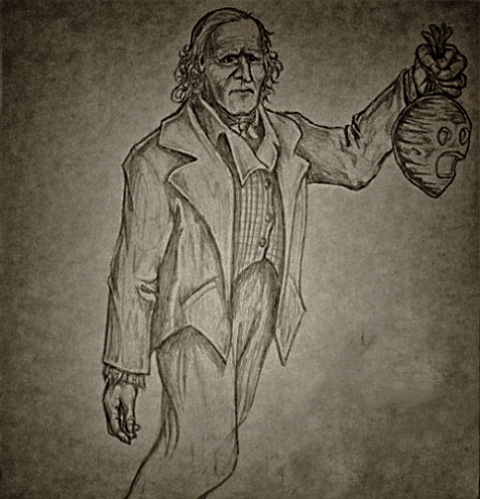
The Middle Ages in Britain and Europe had small children to scare of the crows. They would run around in the fields, clapping blocks of wood together to frighten away birds that might eat the grain. As the medieval period wound down and populations decreased due to plague, farmers discovered there was a shortage of spare children to shoo birds away. In medieval England, farmers secured animal skulls to posts in order to frighten away birds and other animals from the crops. But before long, those in Britain and Europe took to stuffing old clothes with straw, placed a turnip or gourd up on top, and mounted the figure in the fields. They soon realized these lifelike guardians did a pretty good job of keeping crows away.

The scarecrow took care of the crops. His size corresponded to the height of the cornfield and it was coated with wax from nine beehives. A witch doctor placed the eyes, which are two beans; the teeth are maize and nails made of white beans; he is dressed in “holoch” (corn husks). Each time the witch places one of these elements on the scarecrow, he calls to the four winds to protect the corn.

 
Scarecrows came to North America with European emigrants. German settlers in Pennsylvania brought with them the bootzamon—bogeyman—which stood guard over the fields. A female counterpart would be added to the opposite end of the field or orchard sometimes. In the southern Appalachians, another common method of scaring off crows was use of a dead crow hung upside down from a pole.

Mayan Scarecrow Myth:
The scarecrow is presented to the Sun God and given as an offering to the Rain God. Fragrant herbs and anise are burned, and the sacred fire is kept burning for about an hour. Meanwhile, the witch doctor distributes “balché” to the witnesses, which is a very intoxicating liquor, so that the humans won’t be aware when the gods come down to earth. The ceremony should take place when the sun is in the middle of the sky. At that hour, the witch doctor makes a wound on the little finger of the owner of the cornfield, then squeezes out nine drops of blood into a hole in the right hand of the scarecrow; this hole reaches to the elbow.
The witch doctor closes the hole in the scarecrow's hand and in a peremptory voice commands: "Today your life begins. This man (pointing to the owner) is your lord and master. Obedience, scarecrow, obedience ... may the gods punish you if you fail. The cornfield is yours. You must punish the intruder and the thief. Here's your weapon." At this moment he places a rock in the right hand of the scarecrow.

During the burning and the growth of the cornfield, the scarecrow is covered with guano palm, but when the fruit starts to emerge, he is uncovered.
The people say that if a thief or mischief-maker tries to steal the crops, he is stoned to death. Therefore, in the cornfields where scarecrows stand guard, nothing is ever stolen. After the harvest, a “hanincol” (meal in the cornfield) is served in honor of the scarecrow. After the ceremony, wax scarecrow is melted and the wax is used to make candles, which are burned in the pagan and Christian altars.

Next time, you drive past a field and see a scarecrow, think. Are they truly scary, or is it all bad press?


Friday, October 09, 2015

Supernatural Friday: Defining a Haunting


Defining what is a haunting should be simple. Right. Like this traditional description from a dictionary: a haunted place is somewhere inhabited by apparitions or ghosts. These definitions reflect cultural traditions. We are all immersed in our culture and naturally pick up these ideas whether we are aware of it or not. And yet, experts in the paranormal field have so many explanations.
.

An important question; A lot of recent ghost research is based around comparing 'haunted' and 'non-haunted' locations When one looks for differences between the places, there is hope that vital clues will be found to the true nature of hauntings. For such research to be of value, it is vital that a way be found to define a haunting.

For most people, a sighting of a spirit is the normal reason for a haunting. And yet, there are more. Sounds, like footsteps, knocks and disembodied voices. Odors, whether terrible or sweet. Something familiar with a person in life, like cigar smoking, maybe smelled in his home after death. Odd sights not a full body apparition. Feelings: headaches, static build-up, touches, and cold spots.  Object movement: doors, taps and light switches, dishes thrown, objects lost and sometimes recovered, objects falling (eg. pictures, ornaments). Plus there are the reactions from pets of something not visible to our eyes.

Now when one investigates a haunting report and explains all its components using natural causes, would it cease to be a haunting? Most people would most likely agree. Note, however, that a haunting is usually composed of several components or different phenomena. Each component may turn out to have a different, unrelated mundane cause. You could, therefore, conclude that such a haunting, as a whole, was only a single concept in the mind of its witnesses.
What if you can explain most of the phenomena in a haunting but not all of them? Is it still a haunting? It could be that the only thing preventing you for explaining the entire haunting is a lack of crucial evidence. Nevertheless, it still contains some vital 'unexplained' components. So, another definition would be a collection of odd, apparently paranormal, events reported at a particular location, at least some of which have not, on proper investigation, been explained by natural causes. Not as cool as a place inhabited by a ghost, but still, an explanation.

But no matter what “Ghost Hunters” or the others say, no one really knows what a ghost is. Sometimes it is an intelligent haunt, where you received answers and learn it was someone who passed away, like I got over my ghost box, the first and last name of a man, Philip Barnes, who died in the 1622 Massacre at Falling Creek Ironworks.  Other times, it is like a recording, where something repeats itself at a certain time or certain day. Not a ‘real’ phantom.  Then there are ‘demons’, possible theories of time travel, etc… So many reasons, so many “who knows the truth?”  

No matter the possibility. We still enjoy reading about haunting. Taking ghost tours, or watching paranormal TV shows and movies. And at this time of the year, when Halloween is when the veil between the living and the dead is at its thinnest, it’s all about enjoying that chill up our spine.


                         Happy Haunting.


Thursday, October 01, 2015

Supernatural Friday: Just in Time for Joaquin, a Ghostly Legend of the Gray Man


I've written about this ghostly legend before--last year, in fact. But with the hurricane Joaquin maybe hits here on the East Coast in a couple of days or so, I thought this would be a great, timely ghost story for the first Supernatural Friday in October. The legend of the “Gray Man.”


Pawleys Island, the barrier island, the incorporated town and the unincorporated community, all of the same name, is about 26 miles south of Myrtle Beach, S.C. along US Highw 17. It is here that the Gray Man haunts. The name of the island came from George Pawley, an early owner.


The area is one of the oldest resort areas along the east coast. Inland rice planters were believed to have constructed "summer cottages" on the island which, because of its consistent sea breezes, was less infested with mosquitoes, in the 19th century. In 2000 U.S. Census, it stated that there were 138 souls on the island, but that number may be incorrect. Locals claim there is an additional soul who appears from time to time, a soul whose sole occupation seems to be to warn residents of approaching storms.


"The Gray Man" is a good name for the apparition, as it appears to be the size of a man wearing drab, nondescript clothing. The apparition appears and vanishes within the blink of an eye. Sometimes the ghost speaks and sometimes it remains silent. The spirit has been seen along the beach at Pawleys Island off and on now for almost two centuries.


The first appearance goes back to a hurricane that hit the region in 1822, which caused over 300 deaths. Another sighting happened before a terrible storm called "The Sea Islands Hurricane." This storm made landfall near Savannah, Ga., on Aug. 27, 1893. With sustained winds of 120 mph, this hurricane killed 1,000 to 2,000 people and did, by 2010 U.S. dollars, $24.1 million in damages. Another hurricane from October of 1954, Hurricane Hazel, clobbered the Carolina coast, destroying some 15,000 homes and structures, killing 19 people, and doing $136 million in damage. Seventy-three miles up the coast at Holden Beach, N.C., all but 12 of 300 cottages were obliterated by winds estimated at between 125 and 150 mph. 


Now, there was a couple of newlyweds on Pawleys Island. They were supposedly warned by a "man in rumpled gray clothing." He awoke them when he knocked on their door early in the morning before the storm's arrival They prudently left the area as soon as they were able.


Other Pawleys Island residents reportedly observed a solitary "gray man" ambling along the beach, just before a storm hit.  When Hurricane Hugo roared through,  doing damage as far inland as the North Carolina piedmont in mid-September of 1989, it caused at least 76 deaths and did an estimated $10 billion in damages. Before this one appeared, tw Pawleys Island residents saw a man entirely dressed in gray on the beach. The lone pedestrian looked as if he was approaching the couple, but when they waved to him, he disipated. Evidently they were familiar with the legend of the Gray Man, for they packed up and vacated the island two days before Hugo arrived.


Another facet of this legend, is that residences of those whom the Gray Man warns are often not touched by these storms which level surrounding neighborhoods. As with all such tales there are several variations-there are at least three-as to the origin of the ghost.


The one most folks know goes like this:
It seems that there was this young engaged couple. The young man was separated from his beloved for several months, perhaps on a voyage across the Atlantic. When his ship finally put in at Georgetown, he rode a horse (some versions say he was accompanied by a friend or servant) back home to Pawleys Island.
In a hurry to see his young lady, the rider(s) decided to take a shortcut through the swamps. The betrothed young man and his horse became mired and were overcome by quicksand. His companion [if there was one] was unable to save him. 


Later, after his funeral, his lady love saw an apparition resembling the young man when she was walking along the beach. The apparition warned her to take her family and flee the island. She did so and upon returning after the storm, found her home almost the sole surviving structure.
There is also a tale concerning a ghostly couple that are said to occasionally visit the Pelican Inn on the island. Whether the male of the duo is also the Gray Man has not been established.


The legend of the Gray Man of Pawleys Island has been the subject of the TV program, "Unsolved Mysteries," and has been featured in many books about Carolina ghosts. 


I wondered if the “Gray Man” appeared before Sandy’s appearance. It would be understandable if the ghost had, as this hurricane not only came upon the east coast not only the end of October, but close to a time when spirits are said to roam the earth: Halloween.


Friday, September 25, 2015

Supernatural Friday: Jack-O-Lantern-Truth and Folklore

Next Friday, there will be no Supernatural Friday, as I will be on a book tour for my new release, Paranormal Petersburg and the Tri-Cities Area, and stop on my log on Tuesday, September 28th, so come back then and leave a comment with your and email to be entered to win a signed copy of my book.  Next Friday, I will be stopping on Lela Markham's Blog


We carve jack-o-lanterns from pumpkins around Halloween. People carve monstrous faces the pumpkins wear friendly faces, or famous characters from movies, TV and books--like the stormtrooper one my husband carved in one of the craft pumpkin we bought a few years ago. And yes, you don't have to use the gourds you find at the supermarket or grown at pumpkin farms, you can use craft pumpkins found at craft stores, too. You can also paint pumpkins even. This is safer for children to do, rather than using carving implements. They can use their own paints to paint cool faces or by using stencils, faces or scenes on the flesh of the pumpkin.

This tradition of making a jack-o-lantern goes back long ago in Ireland. They used turnips then. The Irish carved these vegetables and left them on doorsteps to ward off evil spirits. But it did not become part of Halloween until 1866. That was in America, and not in Ireland or Britain. There is no documented proof to substantiate that the jack-o-lanterns were ever part of Halloween before this date.
There is folklore behind the jack-o-lantern. In one version of the story, Stingy Jack was a miserly old man who runs into the Devil. He asks if the Devil would turn into a coin he could use to pay some Christian villagers he owed. These that would be a great joke.

But Jack pocketed him. He had a cross in the pocket, too. The Devil was stuck, and the only way he would be freed was if he promise not to take Jack's soul when he dies. The Devil agreed to the deal and set free.

Jack finally passes away. His spirit tries to enter into Heaven, but the gates remain shut to him. There is too great of a stain on his soul for Heaven to allow him inside. And thanks to his agreement with the Devil, he discovers that he is barred from Hell, too. The Devil tosses him a turnip and an ember made from Hellfire.

“Take that turnip, dig all its insides out, and place the ember inside it. Use it as a lantern to find your way across the mortal world to find a resting place. That is all I will do for you. Good riddance.”

So with only the lantern to light his way, Jack wanders the earth and searches for a resting place. He never finds it. Jack became known as Jack-o'-Lantern.
There are other versions of this Irish tale, even an African-American one. One of those tales uses the Grim Reaper in place of the Devil, The Grim Reaper takes Jack's head to Hell with him. Jack uses a pumpkin to replace his head.

When you carve that pumpkin, and set a lighted candle or battery operated candle inside it, stand on your porch and watch the costumed children wandering the street. Think of Stingy Jack, doomed to roam the earth forever.


Will you take pity on him if he comes to your door?

Friday, June 26, 2015

Supernatural Friday: Can Weather and Other Things Affect the Paranormal?


 http://www.westsydneyparanormal.org/uploads/3/9/0/3/3903302/163568.png?363

With some much I had to do today and the person for my interview couldn’t do it, I am posting this post from August 2011. Appropriate after all the bad thunderstorms we went through here in Virginia past couple of days.
My adult son told me he heard a loud bang last night from the office as we slept and he ran into there, only to find nothing undisturbed. When I said it might be from an aftershock from the earthquake that hit Virginia, he said only heard the bang from one wall and nothing shook. I thought that maybe it was a ghostly presence? And wondered if spirits are affected by disturbances like quakes, hurricanes, and more, like it is said thunderstorms can cause things to do with the paranormal.

As the living here scramble to prepare for Hurricane Irene, do ghosts react negatively or positively to this threat too? Did the quake and its aftershocks make more paranormal activity along the East Coast than normal?

At http://www.examiner.com/christian-living-in-raleigh/is-the-world-ending-part-1-earthquakes-hurricanes-tornadoes-wars-debts they talk about how this might suggest the end of the world as prophesized. But my concern is more in how the atmosphere from first the quake and now the hurricane might make phantoms appeared more often than the norm.

I do know that there are spirits who forewarn those of approaching storms, like the Gray Man of Pawley Island, South Carolina. He always appears just before a storm hits the island, warning the inhabitants. When the "Storm of 1822" slammed the area, most perished, except one young girl and her family. According to legends, she was warned by the phantom of her departed lover. A man in 1954 was also warned by a stranger to take his family and flee. The man returned after the storm left the area only to find most of the island in shambles, except for his house. Even the wash was still left on the line! That is another facet of the legend, that those who see the Grey Man means that no harm will come to them.

Another is the "Gray Man" of Hatteras, North Corolina. Legends says that the ghost is of a sailor named Gray, who perished on his ship when it was caught in a hurricane. He hangs close to the lighthouse, warning those of the approaching storms. Those who do not heed his warning are doomed to die when the hurricane hits Hatteras.

So when Irene leaves the East Coast, take notice of anything strange. Do you hear voices when no one is there or suddenly, do things on your shelves fly off ? It would be interesting to check out. And if you see the Gray man, listen to him.

Friday, May 01, 2015

Supernatural Friday: May Day/Beltane-Let's Dance Around the May Pole


May 1st is the first day of May. But it is more than that. I remeber in sixth grade, we dressed up and danced around a may pole at the elementary school I attended in San Diego. It was all about dancing around a pole with ribbons. It goes back to Beltane and pagan rites.

With the Roman invasions of Western Europe and Britain, much of the symbolism and rites of the Floralia and Beltane became entwined -- eventually becoming the holiday we now call May Day or Walpurgis.  The custom of going 'a-maying', collecting flowers, greenery and the maypole early on the morning of May 1, survives virtually intact to this day. Same are the balefires in Britain, Germany, and other countries of Europe.  The sexual aspect of the holiday, however, has become almost extinct in many countries.  The festivities were viewed as sinful by some Christian leaders, and in 1644, the celebration was banned by the Puritan-controlled Parliament in Britain.

Druids and their successors raised the Beltane fires on hilltops throughout the British Isles on May Eve. These fires were lit in order to bring the sun’s light down to earth. In Scotland, every fire in the household was extinguished, and the great fires lit from the need-fire kindled three times by three men, using wood from nine sacred trees. When the wood burst into flames, it proclaimed the triumph of the light over the dark half of the year.

Then people thrust brands into the newly roaring flames and whirled them about their heads in imitation of the circling of the sun. As the sun rose at dawn, those who had stayed up to watch it might see it whirl three times upon the horizon before rising in all its summer glory.

Beltane was also considered one of the three "spirit-nights" of the year when the faeries could be seen. Stories talk that at dusk, one must twist a rowan sprig into a ring and look through it, so that you might see one of them, or more.
 http://www.starfm.com/files/may-day-angel-flowers-pink.gif
Veils between  the mortal world and other worlds are claimed to be thin on this day (like All Hallow’s Eve), and it is said that the Queen of the Faeries rides out on her white horse. Roving about on Beltane eve, the Fairy Queen tries to entice people away to the land of the Faeries. Legend has it that if you sit beneath a tree on Beltane night, you might see the Faery Queen or hear the sound of her horse's bells as she rides on her night ride. The legend also says if you hide your face, she will pass by, but if taking one glance at her may have her choose her to go with her. A Scottish ballad called Thomas the Rhymer, tells of this, in which Thomas chooses to go with the Queen and never seen afterwards.


According to old folklore, May is not a favorable time for marriages in the legal and permanent sense. References in the old books of this belief, say woe is to had by those who do marry during this month. One reason might be is May is the pagan handfasting month.

 http://magickalgraphics.com/Graphics/Occult/Sabbats/Beltane/beltane25.jpg

Friday, February 20, 2015

Supernatural Friday: Winter is Hunting Season

Winter is Hunting Season
by
Pamela K. Kinney 
(copyrighted to the author, so please just share the link, not take the poem)
Winter’s cold fingers touching my skin
Nothing to fear,
Except freezing to death;
Right?
But the coldness
Brings the monsters
They want to play;
Play with you
In so many ways.
Less people in the woods,
It’s Sasquatch’s time.
Werewolf is drawn
To towns more.
Ghosts don’t feel
So they haunt--cold or hot
Zombies?
They can eat anytime!
As for vampires
They’re icebox cold too.
So who told you winter’s safe?
It’s just another hunting season--
For monsters!

Thursday, October 09, 2014

Supernatural Friday: Eleven Spooky Supernatural Reads for October


For this Supernatural Friday, I decided to do eleven spooky reads perfect for October and Halloween. Not to say, they aren't wonderful, to read any other time. There are more creepy novels and short stories I can tell you about, but then that might go into the hundreds. Instead, I feel these eleven will be a great start for you. Plus at the end, there is a link for my own scary ghost story that made the top seven stories for Small Press Award 2013.  Now get reading!

1.     The Haunting of Hill House by Shirley Jackson (It’s not Halloween without a great, scary ghost story. This is the only novel to scare me during the daytime, in a room full of middle school student. My parents landlady had given this book and Jackson’s We Have Always Lived in the Castle (another good read), so after getting my work in class done early the teacher said I could read my book, so I did. The scene I read freaked me out.)

 Front Cover

2.     The Wolfen by Whitley Strieber (A werewolf horror novel, but where the werewolves are shifters, but a race living alongside humans since prehistoric times.  Though no longer in print (you can find it used—I did—it is available of Kindle and Nook.
 Book blurb: In the dark, they are watching...
They are waiting for you. No one has ever lived to tell the horrifying truth about them. Yet even now the Wolfen are gathered in the night-dark alleys ... unseen, poised ... ready to destroy their helpless human prey. Only one man and one woman, trained cops, willing to risk their lives, stand in the way.)

3. Bad Wolf by Tim McGregor (I got this free on Kindle—which I see it is again—and though self-published, it was good. Enough for me to buy the second two in the Bad Wolf Chronicles trilogy.

 Book blurb: Detective Lara Mendes’s hard work finally pays off   when she gets the chance to join the homicide detail. There’s only one catch; she has to partner up with a cop no one wants to work with.

John Gallagher is a veteran homicide detective who loves stomping bad guys and hates partners. When the Lieutenant saddles him with this green kid named Mendes, his first reaction is to ditch her but a call comes in about a body on the river bank and the rotation says they’re up.

What they find are human remains, mutilated and partially devoured. Their investigation reveals a killer stalking the city with a pack of vicious, feral dogs.
And the suspect believes he is a werewolf.

But this is Portland, where crazy bastards outnumber normal ones ten to one. Except there’s another catch. The crazy werewolf guy? He isn’t crazy...


4.     Dracula by Bram Stoker( Forgot that Twilight junk and read the vampire that start it all (even though there was a vamp novel before him). With ‘Dracula Untold’ coming to movie theaters, showing how he became the monstrous Count, I would suggest start reading the book. And no, he may walk in the daytime, but he does not sparkle! If cannot afford the book or eBook, or it’s out at your library, you can read it free here: http://www.literature.org/authors/stoker-bram/dracula/  or get it at Gutenberg as download for free: http://www.gutenberg.org/ebooks/345 Read the short story, “Dracula’s Guest” for free at http://www.literature.org/authors/stoker-bram/draculas-guest/ or get it at Gutenberg too, as free download: http://www.gutenberg.org/ebooks/10150


5.     Hell House by Richard Matheson (You think it was Hill House again, but it is not. What really haunts Hell House?

Front Cover

6.     “The Monkey’s Paw” by W.W. Jacobs (Not a novel, but a very, scary ghost story. Remember that motto, “Be careful what you wish for?” as this story fits it so well. Sometimes the dead should remain dead.) The Monkey’s Paw,” one of the most bone-chilling and frequently anthologized stories of all time. Readers will find it difficult to believe that W(illiam) W(ymark) Jacobs (1863-1943) gained his fame as a writer of humorous tales, as there is no hilarity to be found here. It has been adapted relentlessly: for radio, as a 1907 play, motion pictures (several silent films as well as a 1933 talkie and a 1948 remake), for television as episodes of Suspense, Great Ghost Tales, The Alfred Hitchcock Hour, and Great Mysteries, and for three operas. “The Monkey’s Paw” was first published in the September 1902 issue of Harper’s Monthly; it was collected in The Lady of the Barge (London, Harper, 1902). You can read it here for free.


7.     All of H.P. Lovecraft’s stories and novels (Something about the Old Ones that can creep to a person, don’t you agree?)


8.     Salem’s Lot and It by Stephen King (I compiled these two together, as both scared me when I read both books alone in my bedroom, just before bedtime. )

      Front Cover

9.    Something Wicked This Way Comes by Ray Bradbury (I love all of Ray Bradbury's works, but this one is a great favorite of mine.

Few American novels written this century have endured in th heart and mind as has this one-Ray Bradbury's incomparable masterwork of the dark fantastic. A carnival rolls in sometime after the midnight hour on a chill Midwestern October eve, ushering in Halloween a week before its time. A calliope's shrill siren song beckons to all with a seductive promise of dreams and youth regained. In this season of dying, Cooger & Dark's Pandemonium Shadow Show has come to Green Town, Illinois, to destroy every life touched by its strange and sinister. 


 Front Cover

10.     Rosemary’s Baby by Ira Levin (Got to have one demon or Devil story with witches to read for Halloween. Forget The Exorcist—that bored me—but this one stuck in my mind for years.


11.  Complete Tales and Poems by Edgar Allan Poe (You thought I would forget him? Heck, no! He’s is perfect for this time of the year.)


Now read my fictional ghost story, Bottled Spirits at BuzzyMag.com for free.